Did you know that choosing the right type of wood for outdoor use can make the difference between an installation that lasts for decades and one that deteriorates in just a few years? Exposure to sun, rain, and temperature changes puts the resistance of any wooden surface to the test.
That’s why knowing which species are the most durable—and how to treat them properly—is key to achieving long-term aesthetic and functional results.
Why is it important to choose the right type of wood for outdoor use?
When it comes to terraces, porches, façades, or swimming pools, wood is constantly exposed to factors that accelerate its natural wear. Moisture, UV rays, and wood-boring insects can affect its stability and appearance if the right species is not selected. For this reason, the type of wood for outdoor use must have three essential qualities:
- High density and natural durability.
- Resistance to moisture and fungi.
- Dimensional stability in the face of climate changes.
In addition, it’s important not to overlook the role of protective treatments and finishes specifically designed for outdoor use, which extend the wood’s lifespan and reduce the maintenance required.
The most durable types of wood for outdoor use
At Yvyra, with more than 40 years of experience in manufacturing high-quality wooden flooring, we know that choosing the right material depends not only on personal taste, but also on technical knowledge of each wood’s properties. Below, we explain which options are the most resistant, how they perform outdoors, and which professional solutions we recommend for exterior projects.
1. Ipe: the queen of durability
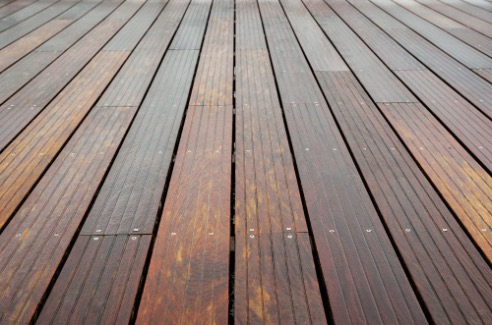
Ipe (also known as Lapacho) is one of the most highly valued materials for outdoor use. Its exceptional density and hardness make it one of the most resistant woods in the world. It withstands moisture and temperature changes extremely well, without easily warping or cracking.
Thanks to its stability and natural beauty, it is an ideal option for outdoor decking, façades, or pool surrounds. Its dark brown color and fine texture add unmistakable elegance to any space.
At Yvyra, we incorporate this type of wood into our 10AK Único collection, specifically designed for projects where durability and natural aesthetics are essential.
2. Teak: tropical elegance with high resistance
Teak is another of the most resistant woods for outdoor use, especially due to its natural oil content. These oils act as a protective barrier against moisture, mold, and insects, making teak an excellent choice for maritime or humid environments.
In addition, its golden tone and warm feel make it ideal for high-end terraces and outdoor furniture. With proper maintenance, teak retains its color and texture for many years, even in harsh weather conditions.
3. Elondo and Merbau: resistant and sustainable alternatives
For those seeking a balance between resistance, sustainability, and aesthetics, species such as Elondo or Merbau are recommended alternatives by Yvyra experts. Both have medium-to-high density and natural durability against fungi and insects, making them very suitable for long-lasting outdoor projects.
These woods are also easy to work with and respond excellently to protective treatments, which expands their potential use in both residential and commercial spaces.
4. Thermally treated woods: innovation and sustainability
In recent years, thermally treated woods have gained prominence in architecture and exterior design. Through a controlled heat process, their resistance and stability are improved without adding chemical products.
This treatment turns local woods, such as ash or pine, into materials with performance similar to tropical species, but with a lower environmental impact. At Yvyra, we are committed to this type of solution in collections such as Millesime, where innovation and sustainability go hand in hand with contemporary design.
Factors that determine the resistance of outdoor wood
Choosing the species is only the first step. Other factors directly influence the durability of the type of wood used outdoors, such as:
- Pre-treatment: applying specific oils, varnishes, or protectors extends its lifespan and prevents excessive water absorption.
- Professional installation: proper ventilation beneath the surface and the use of suitable fixing systems are essential to prevent warping.
- Regular maintenance: cleaning and periodic reapplication of oil or wood stains help keep the wood looking like new.
At Yvyra, we combine the selection of premium materials with optimized installation systems to guarantee long-lasting results, even in the most demanding environments.
FAQs about outdoor wood types
What is the most durable wood for outdoor use?
Ipe is considered the most resistant and durable type of wood for outdoor applications thanks to its density and high dimensional stability.
Can natural wood be used around swimming pools?
Yes, as long as a moisture-resistant species (such as Ipe or Teak) is chosen and specific protective treatments are applied.
What maintenance does outdoor wood require?
It depends on the type of wood and the climate, but generally applying oil or wood stain once or twice a year is recommended.
Are there ecological or sustainable options?
Yes. Thermally treated woods or those certified with sustainability labels are increasingly popular alternatives in eco-responsible projects.
At Yvyra, we combine artisanal expertise with technological innovation to offer durable, sustainable, and design-driven solutions. Our 10AK Único and Millesime collections are the result of decades of research and a strong commitment to quality, designed to stand the test of time without sacrificing the natural elegance of wood.
If you are planning an outdoor project, trust the experience of our experts and discover why Yvyra is synonymous with excellence in wooden flooring.