
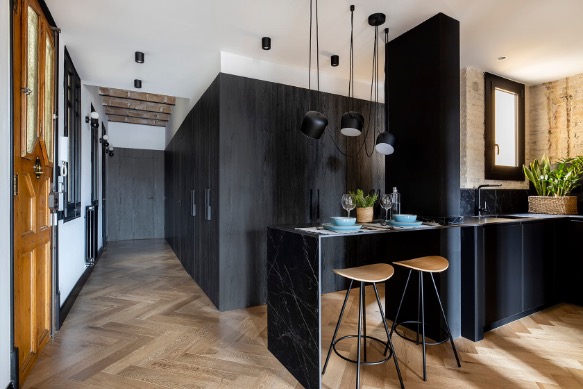
Do you have an old wooden floor and are thinking about renovating it without tearing up the entire floor? This is a very common question during renovations: you can install laminate flooring over a wooden floor, but it’s not always the best solution, nor can it be done just any way.
Before deciding, it’s important to assess the condition of the subfloor, the moisture levels, the levelness, and the type of flooring you want to install. Wood is a noble, warm, and durable material, but it’s also sensitive to changes in humidity and temperature.
That’s why, when considering installing new laminate flooring over an existing hardwood floor, the key issue isn’t just whether it’s technically possible, but whether that subfloor provides sufficient guarantees that the new flooring will perform well in the long term. We’ll walk you through all the key points at Yvyra.
When Can You Install Laminate Flooring Over Wooden Floors
Generally speaking, you can install laminate flooring over wooden floors when the existing floor is firm, dry, level, and securely attached to the subfloor. If the boards do not move, do not creak excessively, do not have sunken areas, and there is no moisture, they can serve as a base for the new installation.
However, if the original floor has loose pieces, bulges, significant unevenness, or signs of deterioration, it’s best to fix those problems first. Laminate flooring needs a stable base. If installed over a defective subfloor, the irregularities can transfer to the new flooring and cause noise, gaps between planks, or premature wear.
The Importance of Choosing High-Quality Laminate Flooring
Not all hardwood floors deliver the same results. In projects where durability, stability, and natural aesthetics are sought, the choice of material is essential. Yvyra, as a manufacturer specializing in hardwood flooring, creates collections designed for interiors with character, where design and technical performance go hand in hand.
The Millésime collection is an interesting option for those seeking hardwood floors with an artisanal character and expressive finishes. Variants such as Napa, Priorat, or Margaux allow you to create elegant, warm spaces with a carefully curated visual presence.
On the other hand, the 1OAK Único collection offers flooring where each plank retains its own unique character. Options like Terral, Galerna, or Mistral can fit seamlessly into contemporary, natural, or more organically inspired interiors.
Should you keep the old floor or remove it?
It depends on the condition of the existing floor. If the old hardwood floor is severely deteriorated, has moisture issues, is poorly secured, or has an unstable structure, removing it may be the safest option. Although it involves more initial work, it allows you to inspect the actual subfloor and prepare a proper base from scratch.
On the other hand, if the floor is sound and level, keeping it can reduce construction time and avoid unnecessary debris. Even so, this decision should not be based solely on cost. Installing hardwood flooring over existing wood must meet technical criteria, not just the convenience of leaving the old flooring in place.
Insulation Underlayment and Installation System
In a floating installation, the insulation underlayment plays an important role. It helps improve acoustic comfort, compensates for minor irregularities, and acts as an intermediate layer between the existing floor and the new hardwood flooring. However, it does not correct serious problems related to moisture, movement, or unevenness.
It is also essential to leave perimeter expansion joints. Wood needs space to move naturally. If the flooring is fitted tightly against walls, pillars, or door frames, lifting or stress may occur. That is why professional installation is just as important as the quality of the flooring you choose.
Finishes and Styles for Renovating a Wood Floor
Installing new hardwood flooring over an existing wood floor can completely transform a room. If you’re looking for brightness, shades like Napa or some light variants of 1OAK Único can create a sense of visual spaciousness. For interiors with more character, options like Toro or Cierzo help reinforce a more immersive aesthetic.
The key is to choose not only based on color, but also on texture, format, the room’s intended use, and the project’s style. A bedroom has different requirements than a high-traffic living room, a family home, or a commercial space.
In short, you can install floating hardwood flooring over an existing wood floor, but only when the subfloor meets the appropriate conditions. Installation must begin with a preliminary inspection, proper preparation, and a well-considered choice of flooring. If done right, the result can be comfortable, elegant, and durable.
For projects where wood plays a leading role, Yvyra’s collections allow you to renovate interiors with high-quality solutions, from the artisanal expressiveness of Millésime to the natural character of 1OAK Único. Because changing the floor isn’t just about covering a surface—it’s about transforming the way a space is lived in and perceived. Visit us!
FAQs on Whether You Can Install Laminate Flooring Over Wood Flooring
Can you install laminate flooring over wood flooring without major construction work?
Yes, in many cases this can be done without complex construction work, provided the existing floor is in good condition. The advantage of a floating installation is that it usually doesn’t require removing the entire previous flooring, which reduces time, disruption, and waste. However, that doesn’t mean it can be installed directly without any inspection. First, you must check for moisture, stability, levelness, and available height. If the subfloor has issues, it will need to be repaired. The absence of major construction work should not be confused with an installation lacking technical preparation.
What happens if the old hardwood floor creaks?
If the old floor creaks, you must identify the cause before installing the new flooring. The creaking may be due to loose boards, lack of fastening, movement in the subfloor, or moisture issues. If you install floating flooring on top without correcting these issues, the noise may continue or even increase. In some cases, it will be enough to secure loose pieces, level specific areas, or reinforce the subfloor. In other cases, it’s best to remove the damaged flooring. The important thing is not to mask the problem, because the new flooring will depend on that subfloor.
Is it necessary to install an insulating underlayment between the two floors?
Yes, it’s generally recommended to install a compatible insulating underlayment between the existing wood floor and the new floating flooring. This layer helps improve acoustic comfort, smooths out minor irregularities, and makes walking on the floor more pleasant. It can also provide additional protection against certain conditions of the subfloor, although it does not replace a moisture barrier when there is a real risk of moisture. The choice of underlayment should be tailored to the type of flooring, the condition of the existing floor, and the needs of the home. An inappropriate underlayment can affect the final performance.
Is it better to install floating flooring or restore the existing wood floor?
It depends on the value, condition, and quality of the original floor. If it is a hardwood floor in good condition, restoring it by sanding and refinishing can be an excellent option. This allows you to preserve the original material and restore its beauty. On the other hand, if the floor is severely damaged, lacks sufficient usable depth, or does not match the desired style, installing new flooring may be more practical. The decision should take into account aesthetics, budget, durability, and intended use. For high-quality floors, it’s always advisable to seek a professional assessment before covering them.
What type of flooring is best to install over wood?
It’s best to choose a stable, high-quality flooring that’s suitable for the room’s intended use. Multilayer wood flooring typically offers a good balance between natural aesthetics and dimensional stability. Additionally, it allows you to enjoy a top layer of real wood that performs better in the face of environmental changes than some traditional solutions. In collections such as Millésime or 1OAK Único, Yvyra offers options with different finishes, tones, and textures to tailor the flooring to the project. The final choice should take into account foot traffic, lighting, decorative style, and the condition of the subfloor.
